|
|
|
PRODUCTS MANUFACTURED BY:
|
|
|
|
|
|
|
|
|
|
|
 |
|
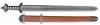
| Hanwei Saxon Sword 9th century (SH2436) |
Points: 25

|
CAS Hanwei’s smiths have outdone themselves with their recreation of a 9th Century Saxon sword by replicating a technique used by the Saxons and Vikings and producing a stunning blade that features a pattern-welded core with high-carbon edge sections. This technique was used by the old-time smiths as a means of producing blades (just for the rich folks) that were sharp, resilient and decorative and, eleven hundred years on, CAS Hanwei has made them affordable.
The sword’s design is based on a 9th Century piece found in the bank of a stream in England in 1976 and now on display in the Yorkshire Museum.
|
|
|
|
|
|
 |
|
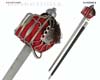
| Hanwei Scottish Basket Hilt Backsword (SH2003) |
Points: 24
|
Early highland swords almost invariably carried the double-edged "broadsword" blade, but by the time of the Battle of Culloden (1746) the single-edged "backsword" was at least equal in popularity.Our Basket-Hilt Backsword, replicated from an original in the collection of the Royal Armouries in England that dates from about 1760, has an unusual basket with twin engraved "horned beastie" plaques and a blade with twin fullers running most of its length. The blade is German in origin, but the hilt and blade are contemporary.
|
|
|
|
|
|
 |
|
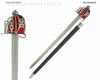
| Hanwei Scottish Basket Hilt Broadsword (SH2002) |
Points: 15
|
Although Basket-Hilt swords appeared throughout Britain from the mid-sixteenth century on, their association with the seventeenth and eighteenth century Scottish highlander has become legendary.
Our Basket-Hilt Broadsword, replicated from an original in the collection of the Royal Armouries in England, carries a typical Glasgow-style hilt from the mid-18th century. It is likely that the blade of the original sword, marked "Andrea Ferara", was made in Germany a century earlier and re-hilted as basket designs were refined.
|
|
|
|
|
|
 |
|
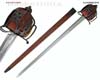
| Hanwei Scottish Basket-Hilt Broadsword (Antiqued) (SH2002N) |
Points: 10
|
Although Basket-Hilt swords appeared throughout Britain from the mid-sixteenth century on, their association with the seventeenth and eighteenth century Scottish highlander has become legendary.
Our Basket-Hilt Broadsword, replicated from an original in the collection of the Royal Armouries in England, carries a typical Glasgow-style hilt from the mid-18th century. It is likely that the blade of the original sword, marked "Andrea Ferara", was made in Germany a century earlier and re-hilted as basket designs were refined.
The sword is available in both polished and antiqued finishes. Both hilts are crafted from stainless steel, to minimize maintenance, that of the SH2002 being polished while the SH2002N "antiqued" version has a museum-quality patina. The high-carbon blade of the SH2002N is also lightly "antiqued" to promote authenticity. The grips of the broadswords are covered with wire-wrapped genuine rayskin and the basket liners are crafted in fabric-covered leather. The scabbards are leather-covered, black in the case of the SH2002 and brown for the SH2002N.
|
|
|
|
|
|
 |
|
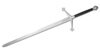
| Hanwei Scottish Claymore (SH2060) |
Points: 12
|
Mainstay of the Highland warriors of the late 15th and 16th centuries, the Claymore had a uniquely styled hilt that sets it apart from other great swords of the period. Typically of hand-and-a-half length, this versatile weapon could deliver great sweeping slashes or powerful thrusts. Replicated from a surviving museum piece our Claymore (SH2060) is classic in its design, with distinctive sloping quillons terminating in quatrefoils and a high-collared quillon block with langets following the blade fuller. The leather-covered grip is topped by a globate pommel. Originally carried slung on the back, the Claymore matches perfectly with our OL1038B back scabbard.
Authentic styling
Fully functional
Excellent balance
|
|
|
|
|
|
 |
|
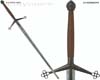
| Hanwei Scottish Claymore (SH2060N) |
Points: 18
|
Mainstay of the Highland warriors of the late 15th and 16th centuries, the Claymore had a uniquely styled hilt that sets it apart from other great swords of the period. Typically of hand-and-a-half length, this versatile weapon could deliver great sweeping slashes or powerful thrusts. Replicated from a surviving museum piece our Claymore is classic in its design, with distinctive sloping quillons terminating in quatrefoils and a high-collared quillon block with langets following the blade fuller. The leather-covered grip is topped by a globate pommel. The sword is available in both polished and antiqued finishes, the finish of the SH2060N closely replicating that of the original museum piece. The grips of the Claymore are leather-covered, black in the case of the SH2060 and brown for the SH2060N. Originally carried slung on the back, the Claymore matches perfectly with our OL1038/OL1038B back scabbard.
|
|
|
|
|
|
 |
|
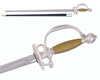
| Hanwei Scottish Court Sword (SH1214) |
Points: 12
|
Quick and elegant describe the Scottish Court Sword. Replicating an original dating from the 1730's and belonging to an officer in Prince Charles Edward Stuart's army at Culloden, the finely chiseled silver-plated hilt and three-edged hollow ground blade exemplify the consummate skill of the swordsmiths of the period. See model SH2324 for the Practical Fencing Court Sword.
|
|
|
|
|
|
 |
|
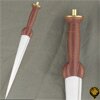
| Hanwei Scottish Dirk (SH2363) |
Points: 8
|
The ever-popular Early Dirk is strikingly authentic, its clean lines and carved hardwood hilt making it a clansman re-enactor favorite. Iberia Swords are crafted in much the same way as swords were made centuries ago, except that the blades are now forged from high-carbon spring steel, a resource unavailable off-the-shelf to the smiths of the old. The blade finish is far from being polished, again more closely replicating what the medieval swordsmith was able to achieve. Except as noted, grips are leather-covered hardwood. Fittings are either steel or solid brass. Except, where shown all of these swords have scabbards of leather-covered fiberglass with steel lockets and chapes and removable suspension rings. These swords will appeal to the re-enactor who wants a sword with the same appearance as the originals.
|
|
|
|
|
|
 |
|
|
|
|
 |
|
| Hanwei Shinto Elite Katana (SH6004KGE) |
Points: 45
|
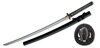
The Shinto Elite (SH6004KGE) features a hand-forged T10 high-carbon steel katana blade featuring the geometry of the Performance Series. The blade is differentially hardened using the traditional claying method. The Shinto is mounted in black and the tsuka-ito is made of premium black Japanese cotton. The saya is finished in a deep black lacquer with a black cotton sageo. A finely rendered dragon, detailed in gold, with true front-and-back detail, forms the black iron tsuba. The fittings are superbly antiqued adding to the aesthetics of the set. The Shinto is supplied with a protective cloth bag and traditional maintenance kit.
|
|
|
|
|
|
 |
|
| Hanwei Shinto Katana (SH1001) |
Points: 30
|
Each piece in the Shinto Daisho (SH1001 & SH1015) has a hand-forged T10 high-carbon steel blade (nagasa) and is differentially tempered using a traditional claying method. The Shinto Daisho is mounted in black and the tsuka-ito is made of premium black Japanese cotton. The saya is done in a deep black lacquer with a black cotton sageo. A finely rendered dragon, detailed in gold, with true front-and-back detail, forms the black iron tsuba. The fittings are superbly antiqued adding to the aesthetics of the set. The blades feature a groove (bo-hi) on both sides and are constructed with a medium length (chu) kissaki. The incredibly popular Shinto Daisho is the cornerstone of our CAS/Hanwei line of Samurai weapons.
Forged high-carbon steel blade
Built for cutting
Traditional construction
|
|
|
|
|
|
 |
|
| Hanwei Shinto Shinken Katana w Bohi (SH6004SGF) |
Points: 45
|
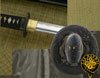
The Shinto Shinken Katana features a more traditional blade style than the other Performance Series models, specifically designed for a more frequent drawing practice, with a live sharp blade.
These live Iaito swords (Shinken) from Hanwei are made for the experienced Iaido practitioner who wishes to include light cutting (Tameshigiri) in his repertoire. The Shinken features optimized blade geometry, combining excellent balance with minimum weight for repetitive drawing, while retaining sufficient backbone for cutting light targets. The Shinto models have hand-forged high-carbon steel blades. Each blade is differentially hardened, to produce a distinctive hamon, and is grooved for balance and audible feedback in the cutting stroke.
|
|
|
|
|
|
 |
|
| Hanwei Shinto Wakizashi (SH1015) |
Points: 25
|
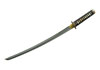
Each piece in the Shinto Daisho (SH1001 & SH1015) has a hand-forged 1065 high-carbon steel blade (nagasa) and is differentially tempered using a traditional claying method. The Shinto Daisho is mounted in black and the tsuka-ito is made of premium black Japanese cotton. The saya is done in a deep black lacquer with a black cotton sageo. A finely rendered dragon, detailed in gold, with true front-and-back detail, forms the black iron tsuba. The fittings are superbly antiqued adding to the aesthetics of the set. The blades feature a groove (bo-hi) on both sides and are constructed with a medium length (chu) kissaki. The incredibly popular Shinto Daisho is the cornerstone of our CAS/Hanwei line of Samurai weapons.
Hand forged Steel
Edge-tempered blade with hamon.
Traditional construction
|
|
|
|
|
|
 |
|
| Hanwei Side Sword (SH2203) |
Points: 14
|
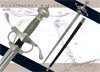
The Side Sword was a military sword of the 16th and 17th century Renaissance period that also achieved popularity among civilians, due to its relatively light weight and quickness. It also had an advantage over its contemporary, the rapier, in having the ability to cut efficiently as well as thrust. Side swords were often the weapon of choice for sword and buckler fighting. Our side sword, based on a German original, is a beautifully proportioned piece that balances very well. The "swept" hilt affords excellent hand protection and the blade geometry makes for outstanding performance in both the cut and the thrust.
|
|
|
|
|
|
 |
|
| Hanwei Sir William Marshall Sword (SH2000) |
Points: 14
|
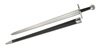
The Hanwei Marshall Sword one-handed sword embodies the quality and authenticity of a sword design. The appearance of the sword is based on the original, currently in the British museum, used by one of the best knights of England, Sir William Marshall, who faithfully served the crown under the reign of Henry II, Richard the Lionheart and Jack Lackland.
|
|
|
|
|
|
|
Tags:
martial arts, katana, iaito, sword, fencing, tonfa, boken, bokken, kama, shinai, samuraj, judo, karate, kenjutsu, kenjitsu, ninja, kungfu,
|



 - New items
 - Clearance sale
 - Discounted items
 - Add to favorites